
Three things to keep
- A share is a small ownership stake in a company; its return comes from dividends and from changes in the price other investors will pay.
- Shares trade on regulated exchanges during set hours; US trades settle one business day later (T+1).
- Diversification and low costs do more for most long-term investors than picking individual winners.
The stock market for beginners can look like a wall of flickering prices, but the idea underneath is simple: companies divide their ownership into shares, and investors buy and sell those shares with one another on regulated exchanges. This guide explains what owning a share means, how an order becomes a trade, how indices summarise thousands of prices, and the habits that tend to matter most over long periods.
What a share actually is
A share (or stock) is a unit of ownership in a company. Owning one gives you a claim on a slice of the company's future profits and, usually, a vote at shareholder meetings. Companies first sell shares to raise money, often through an initial public offering; after that, the shares change hands between investors, and the company receives nothing from those later trades.
A shareholder can earn a return in two ways. The company may pay part of its profit as a dividend, and the share price may rise if investors come to value the business more highly. Neither is guaranteed: dividends can be cut, prices can fall a long way, and a company can fail entirely, leaving ordinary shareholders last in line.
An illustrative dividend example
Suppose you buy 20 shares at $150 each, a $3,000 investment. If the company pays a dividend of $0.60 per share each quarter, that is $2.40 per share a year, or $48 in total. The dividend yield is $2.40 ÷ $150 = 1.6%. If the share price later rises to $180, the yield on the new price falls to about 1.33%, even though you still receive the same $48.
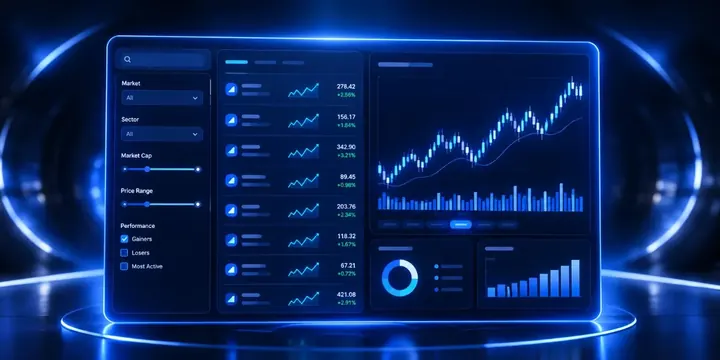
How the stock market for beginners works in practice
Shares trade on exchanges such as the New York Stock Exchange and Nasdaq, the London Stock Exchange, Germany's Xetra, the Tokyo Stock Exchange or the Hong Kong exchange. Each runs a central order book: a list of all the prices at which people are currently willing to buy (bids) and sell (asks). When a buy order and a sell order meet at the same price, a trade happens.
Private investors do not deal with the exchange directly. They use a broker or investment platform, which passes their order to the market, and a custodian holds the shares on their behalf, usually separately from the firm's own assets.
Order types
- Market order: buy or sell straight away at the best price available. Fast, but the price can differ from the one you saw, especially for less traded shares.
- Limit order: buy or sell only at your chosen price or better. You control the price, but the order may never fill.
- Stop order: becomes a market order once the price reaches a trigger level, often used to limit losses. In a fast fall it can fill well below the trigger.
Settlement
Settlement is the moment ownership and money actually change hands. In the United States, share trades have settled one business day after the trade (T+1) since May 2024. Other markets follow their own timetables, so check the rules of the exchange you are using.
Reading the basics of a company
Share prices on their own say little about whether a company is large, small, cheap or expensive. Three measures appear in almost every quote:
- Market capitalisation: the share price multiplied by the number of shares. A company with 1 billion shares at $150 has a market value of $150 billion.
- Earnings per share (EPS): the company's profit divided by its number of shares.
- Price-to-earnings ratio (P/E): the price divided by earnings per share. At $150 with EPS of $7.50, the P/E is 20, meaning investors are paying $20 for each dollar of annual profit.
These figures use made-up numbers and are starting points, not verdicts. A high P/E can reflect expected growth or excessive optimism; a low one can signal value or trouble ahead. Company annual reports, filed with the relevant securities regulator, are the primary source for the underlying numbers.

Trading hours around the world
| Exchange | Regular session (local time) |
|---|---|
| NYSE and Nasdaq | 09:30 to 16:00, New York |
| London Stock Exchange | 08:00 to 16:30, London |
| Xetra (Frankfurt) | 09:00 to 17:30, Frankfurt |
| Tokyo Stock Exchange | 09:00 to 11:30 and 12:30 to 15:30, Tokyo |
| Hong Kong Exchanges | 09:30 to 12:00 and 13:00 to 16:00, Hong Kong |
| Australian Securities Exchange | 10:00 to 16:00, Sydney |
| NSE and BSE (India) | 09:15 to 15:30, India time |
Exchanges close on public holidays, and some offer extended sessions before and after these hours with thinner trading. The board on our home page shows which markets are open now.
Indices: the market in a single number
An index tracks a basket of shares to show how a market or sector is doing. They are built in different ways, and the method changes what the number tells you:
- The S&P 500 covers about 500 large US companies, weighted by the market value of their freely tradeable shares.
- The Dow Jones Industrial Average follows just 30 US companies and is price-weighted, so higher-priced shares carry more influence; our guide to the DJIA explains the quirks.
- The Nasdaq Composite includes all shares listed on Nasdaq, while the Nasdaq-100 holds the largest non-financial ones.
- The FTSE 100 follows the largest companies listed in London; Japan's Nikkei 225 is price-weighted; India's Nifty 50 and Sensex follow 50 and 30 companies respectively.
Index funds and exchange-traded funds (ETFs) let investors buy a whole index in one transaction, which is the simplest way to spread money across many companies at low cost.
The European stock market and investing across borders
There is no single European stock market. Each country has its own exchange or belongs to a group of exchanges: Xetra in Frankfurt, the London Stock Exchange, the multi-country Euronext network and several others. Germany's DAX tracks 40 large German companies and, unusually, is a total-return index, meaning it assumes dividends are reinvested, so its level is not directly comparable with price-only indices such as the FTSE 100.
Buying shares listed abroad adds a layer of currency risk. A US share bought from a sterling or euro account rises and falls with the dollar as well as with the company's fortunes, and many platforms charge a conversion fee on the way in and again on the way out. Our forex guide shows how exchange-rate moves can change a result even when the shares themselves stand still.
Accounts and taxes
How you hold shares affects what you keep. Many countries offer tax-advantaged accounts for long-term saving; in the UK, for example, the Individual Savings Account (ISA) allowance is £20,000 for the 2026/27 tax year, and from 6 April 2027 no more than £12,000 of that may go into a cash ISA for savers under 65. Rules differ widely between countries and change over time, so check your own tax authority's current guidance.
Some brokers also offer to trade shares as CFDs rather than owning them. A CFD tracks the share price without giving you the share, dividends are paid or charged as cash adjustments, and leverage is allowed, capped at 5:1 for individual shares for retail clients in the UK and EU. That turns a long-term holding into a short-term leveraged bet with daily financing costs, which is rarely what an investor intends.
Habits that matter over decades
- Spread your risk. A single company can fail; a broad index fund holds hundreds.
- Keep costs low. Fund charges, dealing fees and currency conversion come out of your return every year; see how they compound in our trading fees guide.
- Expect falls. Share markets have suffered deep declines in the past and will again. Money you may need within a few years is usually better kept elsewhere.
- Beware of tips. Unsolicited share tips, especially for very small companies, are a classic route into pump-and-dump schemes; our scam guide explains the pattern.
- Check the firm. Use a broker authorised by your national regulator; our checklist covers what to look for.
Reader questions
How much money do I need to start investing in shares?
Many platforms allow small amounts, and some sell fractions of a share. What matters more is keeping fees low relative to the amount invested and only investing money you will not need for several years.
Is there one European stock market?
No. The European stock market is a collection of national exchanges and exchange groups, such as the London Stock Exchange, Xetra in Frankfurt and Euronext, each with its own indices and trading hours.
What does T+1 settlement mean?
It means ownership and cash change hands one business day after the trade date. US share trades have settled on this timetable since May 2024.
Sources
- US Securities and Exchange Commission, T+1 settlement cycle (effective May 2024)
- Exchange trading-hours pages: NYSE, Nasdaq, London Stock Exchange, Deutsche Börse (Xetra), Japan Exchange Group, HKEX, ASX, NSE and BSE
- HM Revenue & Customs and HM Treasury, ISA allowances
- UK Financial Conduct Authority, CFD leverage limits for retail clients